
What is Utopia?
And Why It is Deadly

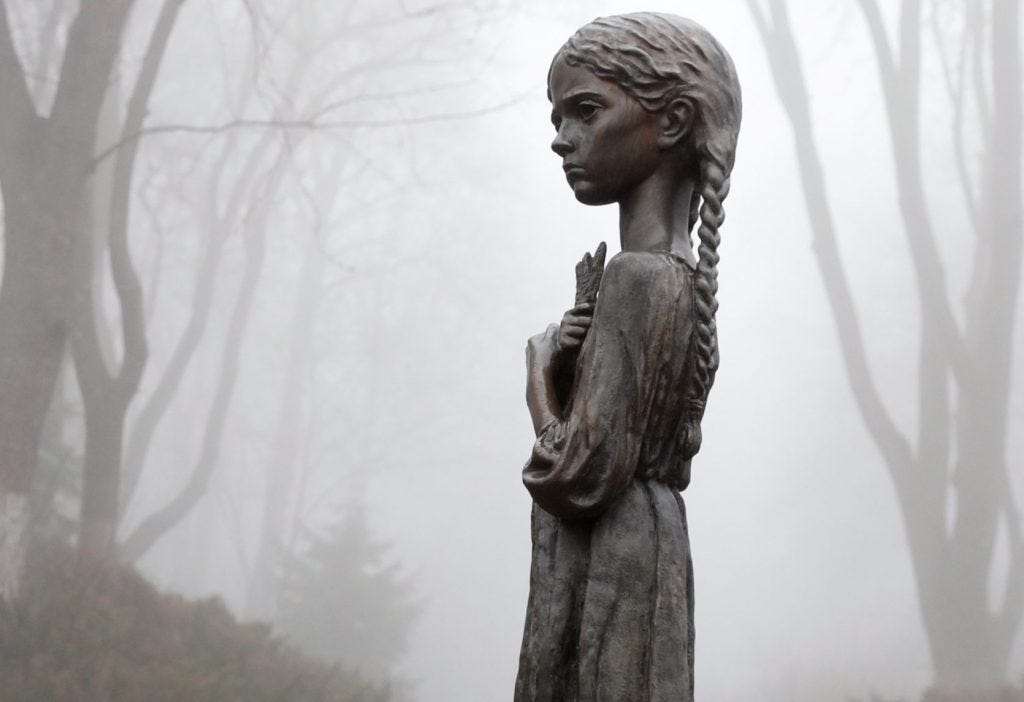
Last Saturday was the Holodomor Remembrance Day. For those not familiar with this genocide: Holodomor or the Terror-Famine was Stalin’s deliberate starvation of Ukrainian peasantry in 1932-1933, which resulted in more than 3 million deaths. The famine was accompanied by stomach-churning atrocities of murder, massacres, and cannibalism. But this post is not about the Holodomor itself, though I urge everybody to read about it here, here, and here. Rather, it is about the reasons why in the bread-basket of Europe, people were reduced to eating corpses. And more broadly: why do the regimes that promise to build a perfect society inevitably resort to violence?
So, why did the Holodomor happen? A very common explanation, embraced by many historians today, is that it was a way for Stalin to crush the Ukrainian demand for independence. There is a lot of truth to it. Ukrainian nationalism was equated with fascism in the USSR - the same equation that Putin uses to justify his aggression against independent Ukraine today.
But the problem is that the Holodomor was not the only terror-famine in the last century. Mao’s Great Leap Forward starved to death at least 40 million people: Yang Jisheng’s book The Tombstone, outlawed in China, sets out the horrifying details of this genocide by starvation. However, the vast majority of the victims were Han Chinese, the country’s dominant ethnicity. While the Holodomor was mostly directed against Ukrainians, the wider campaign of collectivization in the USSR killed millions of Russians, Kazakhs, ethnic Germans and others. It was followed by Stalin’s Great Terror in which, as in the Khmer Rouge’s slaughter in Cambodia, the victims seemed to be chosen at random rather than targeted for race, ethnicity, or religion.
All these genocides have one thing in common: they are motivated by the ideology that promises to build a perfect society. The ultimate goal of Marxism is articulated in the Communist Manifesto of 1848: “In place of the old bourgeois society, with its classes and class antagonisms, we shall have an association, in which the free development of each is the condition for the free development of all”. Or in a pithier summary, communism means “a leap from the kingdom of necessity to the kingdom of freedom”.1 Marx and Engels considered their ideology to be “scientific”. But it is clear that Marxism, in all its political varieties, is about building a utopia, in which all relation of power are abolished, all national, religious, ethnic, and economic hierarchies are erased, and all individuals are equal. The kingdom of freedom is within reach: but something, or rather somebody, stands in the way.
“Utopia” comes from Thomas More’s 1516 book of the same title. More coined the word using the Greek roots of ou-topos meaning “no-place”. However, it can also be read as eu-topos meaning “a good place”. The society represented in the book is strictly regimented and organized, ensuring that all its members are equal and that all property is held communally. Various details of the utopian ideal have changed through the centuries, but all utopias written in the wake of More, from Tommaso Campanella’s City of the Sun (1602) to Ivan Efremov’s Andromeda Nebula (1957), have one idea in common. Society can be forced into perfection if people listen to, and obey, the enlightened vanguard who can clearly see what is best for everybody. But if people refuse, out of selfishness, class interest, false consciousness or simple evil, they need to be eliminated.
In his book Black Mass: Apocalyptic Religion and the Death of Utopia (2007), John Gray writes: “Utopias are dreams of collective deliverance that in waking life are found to be nightmares “. His explanation for this is that political utopias are a secularization of the millenarian-apocalyptic narrative, deeply embedded in the consciousness of the West. In the Book of Revelation of St. John the Divine, the last book of the Christian Bible, Heavenly Jerusalem appears out of nowhere after the protracted period of the Tribulations. Various millenarian cults throughout centuries tried to bring about God’s Kingdom by unleashing violent uprisings and rebellions.2 According to Gray, utopian ideologies such as communism were millenarianism in a new disguise: “secular hopes that inspired the most extreme modern revolutions were not only, or even mainly, demands for specific improvements in society. They were vehicles for apocalyptic myths” (73). And the internal logic of these myths required that humanity be purified by violence before it can be ushered into the Kingdom of Heaven. Without the Tribulations there is no Second Coming.
It is necessary to pause here. Obviously, Marxists and communists were not only actively hostile to Christianity but dismissive of all religions. In fact, the Holodomor itself was accompanied by the desecration of churches, executions of priests, and enforcement of “scientific atheism” in place of theology. But the point about ideology, as I argue in my essay, is that it is a narrative whose meaning is not reducible to its overt claims. Political language is as ambiguous and rich as poetry. Just as there are layers of hidden implications in any story, political ideologies are polysemic: they contain a multitude of meanings and are amenable to almost infinite interpretations. An ideologue always says more than they intend and often more than they know.
So, when Vsevolod Balytsky, a Cheka butcher (who eventually ended up butchered himself), writes about cleansing the Party from the counter-revolutionary “termites” and “pollution”, he appeals to the millenarian logic of purification by violence, deeply embedded in Christian culture (Applebaum 78). And when Robespierre declares that “pity is treason”, he glorifies violence not simply as a regrettable necessity but as a sacred value. As Gray writes:
“Modern political religions may reject Christianity, but they cannot do without demonology…A higher form of human life was within reach - even a higher type of human being - but only once humanity had been purified by violence” (25-26).
This sanctification of violence as the end rather than the means explains so much about the genocides of the last century - the Holodomor, the Terror, the Holocaust, Cambodia, Rwanda. The ostensible political rationale for the Holodomor was that Stalin’s drive for collectivization floundered at the peasants’ unwillingness to give up their farms and to become the government’s serfs. A series of rebellions broke out, with activists sent from the cities to collectivize the countryside being occasionally assassinated (that was the case with my paternal grandfather whose son, my father, was born posthumously; and despite blood being thicker than water, I cannot really fault the anonymous peasant who shot him).
But why was the collectivization necessary at all? The land, formerly in the possession of aristocratic landlords, had been distributed to the peasants, and especially in Ukraine, with its tradition of individual farming, agriculture was picking up and a prosperous middle class was emerging. Left to its own devices, the Ukrainian peasantry could easily feed the entire country with enough left over for international trade. Instead, after the collectivization and up until its demise, the USSR was plagued by chronic food shortages.
The reason was purely ideological, which is to say, delusional. Committed to the Marxist vision of equality, the Party could not accept the emergence of class stratification in the countryside. Free market inevitably meant that some peasants would become more prosperous than others. And thus the kulak was born.
The kulak (the word means “fist” in Russian) was an all-purpose label attached to the rural people who did not fit the Marxist definition of the oppressed. Anybody who had more than their neighbor was cast as an enemy. Peasants were caught in a double bind:
“The peasants knew that if they worked badly, they would go hungry. If they worked well, they would be punished by the state” (Applebaum 86).
The only way to ensure equality was to make everybody equally poor. The same logic that prompts demands for “equity” today required that differential outcomes in wealth be eliminated. And violence is the only logical way in which this can be done. The countryside, which at the time the majority of the population lived, had to be purified from the class enemies who were dubbed “the vermin”, “the bloodsuckers”, and “the lackeys of imperialism”. This rhetorical dehumanization ensured that killing became progressively easier. Erstwhile friends and neighbors turned upon each other; families were robbed of their possessions; children were tossed out naked into the snow. And when the famine struck, death became the great equalizer.
Kulaks were robbed, shot, starved and exiled. Millions of them ended up dumped in the middle of the unforgiving Siberian wasteland where they, and their families, perished from hunger and cold. Others starved in their own villages as grain requisitions and collectivization unleashed the Holodomor in 1932-1933. The deaths were not accidental but deliberate: Pasha Angelina, a Soviet heroine and the first female tractor driver, wrote in her memoir: “Through Comrade Stalin, the Party told us: ‘Move from limiting the kulaks to the liquidation of the kulaks as a class’” (qtd. in Applebaum, 120).
This class genocide remains one of the greatest - and least known - atrocities of the last century. One reason it is seldom mentioned is because it does not fit the legal definition of genocide as accepted today, which limits it to the destruction of a national or racial group. Kulaks were not an ethnic, religious or racial minority. Anybody could have been declared a kulak, just as in revolutionary France or in Cambodia, anybody could have been declared “an enemy of the people”. First, it was anybody who owned slightly more land or animals than their neighbors; then anybody who stood out in their village for any reason; and then literally anybody. Once unleashed, the machinery of killing and starvation could not be stopped until it ran out of steam.
The Nazis had very precise criteria of who a Jew was - anybody with at least three Jewish grandparents (people with one or two Jewish grandparents were called Mischlinge and persecuted but not immediately exterminated). Following their own atrocious logic, they could have succeeded in killing every single Jew in Europe. But the Holodomor, the Terror or the Cambodian auto-genocide had no end-game because their target was everybody. This is why class violence is, in some ways, more terrifying than race violence. The insanity of the show trials in Moscow in 1937 vividly demonstrates why building a utopia inevitably drowns in blood. The judges were trying to force reality to conform to their own distorted vision of social justice - and since reality stubbornly refused to cooperate, somebody had to pay the price of its recalcitrance. Just one more execution, one more death, one more elimination of an “enemy of the people” - and surely, the millennium will come!
The Holodomor and the Terror are forgotten in the West. While the Holocaust has become a political football, with the radical right denying it happened at all and the radical left casting its victims as the perpetrators, few even know what the Holodomor was, and even fewer are willing to consider what it tells us about the dialectic of utopia. But it remains the lesson of history that any pursuit of social perfection is fated to end in violence:
“The peculiar quality of twentieth-century terror is not its scale - unprecedented though it was. It is that its goal was to perfect human life…” (Gray 38).
So when you hear the renewed promises that this time we will get socialism “right”, remember the nameless kulaks buried in mass graves and the starved Ukrainian peasants sacrificed on the altar of equity and justice.
Works Cited
Applebaum, Anne. Red Famine: Stalin’s War on Ukraine. Vintage Books, 2017.
Gray, John. Black Mass: Apocalyptic Religions and the Death of Utopia. Penguin Books, 2007.
The phrase is used in Friedrich Engels’ Anti-Duhring (1878) and Socialism: Utopian and Scientific (1880) and by Karl Marx in Das Kapital (1894).
See Norman Cohn, The Pursuit of the Millennium: Revolutionary Millenarians and Mystical Anarchists of the Middle Ages (1970)
Excellent essay. I still hear people say that the Soviet Union was better than Nazi Germany, because at least it had a good goal, which I'm sure was a comfort to the millions who starved, were shot or froze in Siberia in their final moments.
The rabbis forbade "forcing the end" i.e. trying to bring the messianic age through human intervention for good reason (although primarily because of a fear that the Jews would destroy themselves if they tried another revolt against the Romans. And, yes, I know there are some religious Jews in Israel who absolutely do want to "force the end" through violence).
Great essay.